
Core Objective and Level Flow
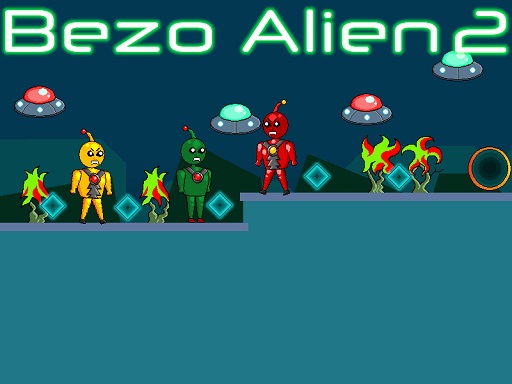
Bezo Alien 2 places you in control of a character who must collect every blue cube scattered across a stage. The cubes are the only path forward: the exit loop hole stays inactive until the last one is picked up. That single rule shapes every decision. You cannot rush to the finish, and you cannot ignore a cube because it sits near a hazard. Each level becomes a route-planning exercise where the safest path is rarely the most direct one.
Hazards and Timing Pressure
Four hazard types appear across the stages: alien creatures, flying UFOs, spinning saws, and sharp spikes. They differ in how they threaten you. Aliens and UFOs move, so their positions change over time. Saws and spikes are fixed, which makes them predictable but no less punishing when a jump falls short. Because the game runs on classic arcade rules, a single touch ends the attempt. The challenge comes from reading movement patterns and committing to jumps at the right moment.
Difficulty Curve Across Eight Levels
The game ships with eight levels that grow harder as you progress. Early stages introduce each hazard in relative isolation, giving you room to learn how aliens drift and how much clearance a saw demands. Later levels combine hazards and tighten the spacing between cubes, so the same jump that worked before now requires a shorter run-up or a delayed takeoff. This escalation keeps the game accessible for casual players while still asking seasoned platformer fans to stay sharp.
Who This Platformer Suits
Bezo Alien 2 targets players who enjoy straightforward arcade platforming without complex systems. There is no inventory, no upgrade tree, and no story gating. The loop is simple: enter a stage, collect cubes, avoid contact, find the exit. The sci-fi presentation and vibrant visuals support that focus rather than distract from it. If you prefer short, repeatable attempts where improvement comes from memorizing enemy timing and obstacle placement, this structure fits that style well.






Editorial Notes